
Slavic Fairy Tales - Part 1
love fairy tales.
I would even go so far as to say that many of my works are written as modern-day equivalents, with large moody worlds, fantastical twists on modern and familiar things, and reflections of recent history through the lens of our modern worries. Our heroic myths exist in modern day with superhero fiction, and so too do modern fairy tales exist.
One of the best fairy tale authors you might not have read is Alexander Pushkin, who is widely known and celebrated in former Soviet Union territories, but not much in the West. I wanted to tell you about a few of my favorite works of his, starting with:
The Tale of the Dead Princess and the Seven Knights
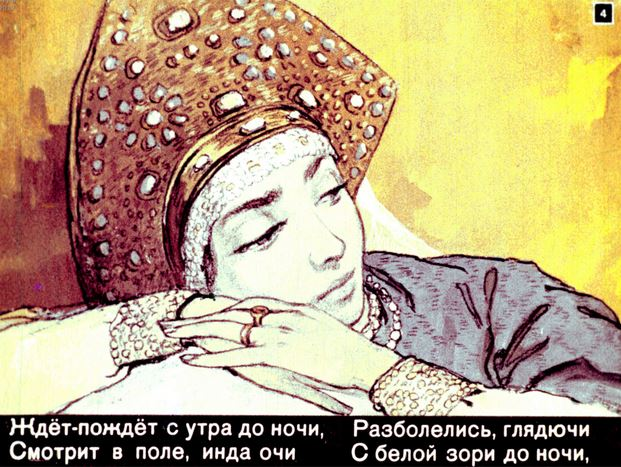
To start us off, most of Pushkin's stories are delivered in the form of novel in verse, or narrative poetry. Poetry is one of the harder things to translate with effective meaning, especially stories mired in cultural norms. This might be why we don't see a lot of Pushkin stories in the West, but onwards we go.
The Dead Princess is primarily similar to Snow White, though with distinct regional differences. There is a beautiful princess, a wicked stepmother who scorns her for her appearance, a mirror that declares the princess the fairest of them all, and 7 men who take care of her once she is cast away from her home by her evil stepmother. Yet, the differences between these two works are still stark.

There are the superficial elements. There's the fact that the dwarves are now knights, there is a servant girl instead of a huntsman who is sent to kill her, our princess gets a dog companion (which is always a plus). But these are swappable, these are pieces that you can take out and re-arrange as you want, still having the same effectively story.
The true difference is the setting. Just by indulging in the visual flair of Slavic fairy tales, you find yourself reading a wholly new story. The fact that the princess is in a crystal coffin instead of a glass one doesn't really matter.
This does.

To me, the aesthetics of this story single-handedly sets it apart from its Germanic counterpart. It is not that Slavic forests or buildings or clothes are inherently better, that their pattern work is more intricate than the ones you find in the Brothers Grimm. Instead it is that by transferring these simple stories into an unfamiliar setting, we impart empathy from ourselves onto the people in it. We know these stories of love and loss, of jealousy and rage. We know these simple feelings in our part of the world. So, do they? What do Slavs fear right now? What are they angry about? These stories help us, in their stripped-down way, to access these emotions.
Gzhel Guardian shares a lot of these aesthetics, both literally and spiritually. It is explicitly meant to be a type of modern-day fairy tale.

If you'd like to experience The Tale of the Dead Princess and The Seven Knights, I'd recommend the 1950s USSR animated version, which you can find subbed on Youtube if you're so inclined. The versions featured in this newsletter are a film-strip version illustrated by Panova L., and books illustrated by Ivan Bruni and V.M. Nazaruk. Also, if you'd like to peruse public domain Slavic Children's Literature, here's a link to Neb.Deti or Neb.Kids.
Next time, I'll be telling you about more of my favorite Slavic fairy tales!
Comments